
CG100
Charge Variant Kit
A simple and robust option for separating protein charge variants in a pI range of 7.0–9.5.

Personalised kits and method development tools to help you design QC and investigation processes, backed by world-class manufacturing and customer support.

A new range of products for analytical customers from Helena Biosciences, with decades of CZE experience.
Enjoy peace of mind by relying on our global, battle-tested R&D, manufacturing and logistics capabilities.
Our objective is to work with you to implement your process design and methods, with the possibility of personalised kit design.
A simple and robust option for separating protein charge variants in a pI range of 7.0–9.5.
The Capillary Zone Electrophoresis Charge Variant Analysis Kit delivers high-resolution, high-sensitivity separation of protein charge variants, enabling detailed characterisation of biotherapeutics with exceptional reproducibility and performance. Based on the proven method developed by He et al., the kit is specifically optimised for proteins with isoelectric points between pH 7.0–9.5, making it ideal for monoclonal antibody and therapeutic protein analysis.
The advanced background electrolyte formulation is designed to maximise charge differences between closely related variants, improving separation efficiency and analytical confidence. Dynamic coating components minimise protein adsorption and tightly control electroosmotic flow, supporting stable migration behaviour, enhanced resolution and highly reproducible results.
The kit also includes optimised conditioning reagents for consistent capillary performance and a dedicated charge variant control standard for system suitability testing and troubleshooting, helping streamline method setup and routine analysis.
Developed for demanding biopharmaceutical workflows, the kit provides a reliable, ready-to-use solution for sensitive charge variant profiling and protein quality assessment.
| Description | Volume |
|---|---|
| CZE Charge Variant Analysis Buffer | 140 mL |
| 0.1M HCl | 100 mL |
| 10mM Phosphoric acid | 100 mL |
| CZE Charge Variant Control | 2 mL |
In SDS-CGE, the separation matrix shapes what you see. We’ve developed the IgG Heterogeneity and Purity range as three focused kits, each designed for a different analytical need.
Sodium Dodecyl Sulphate Capillary Gel Electrophoresis (CE-SDS) combines the trusted size-based separation principles of SDS-PAGE with the automation, sensitivity and reproducibility of capillary electrophoresis. It provides a powerful way to assess the purity, heterogeneity and structural integrity of IgG and other biotherapeutic proteins.
Reduced analysis provides detailed information about individual polypeptide chains, including subunit composition, fragments, glycan occupancy and batch-to-batch consistency. Non-reduced analysis evaluates the intact protein, revealing size-related impurities, fragments, aggregates and structural variants.
The CE Genie range offers three IgG Heterogeneity and Purity Kits, allowing laboratories to select the balance of flexibility, analytical performance and resolution that best suits their application. All three kits include complementary sample preparation buffers at pH 9.0 and pH 6.8, supporting systematic optimisation of protein denaturation while helping to minimise sample-dependent artefacts. An internal standard provides a consistent migration reference, while the modified IgG control contains a defined proportion of non-glycosylated heavy chain for assessment of assay resolution, quantitation and system suitability.
The Classic Kit provides a flexible and dependable starting point for routine CE-SDS analysis and method development. It supports both high-speed and high-resolution separation approaches, allowing users to adapt the method according to their analytical priorities.
High-speed analysis introduces the sample close to the detector, shortening the effective separation length and reducing analysis time. High-resolution analysis uses more of the capillary’s effective length to improve separation. The kit also supports electrokinetic or hydrodynamic sample loading, providing additional flexibility when working with samples whose ionic strength or other characteristics affect injection performance.
With reduced and non-reduced workflows, two sample-buffer conditions and adaptable separation methods, CG200 Classic is a versatile choice for laboratories establishing CE-SDS capability or analysing a varied range of biotherapeutic samples.
The Performance Kit is designed for laboratories seeking enhanced analytical performance and resolution in IgG purity and heterogeneity studies. Its gel buffer and recommended starting methods support robust, reproducible separations while retaining the flexibility needed for application-specific method development.
Hydrodynamic sample injection is recommended when optimum separation of non-glycosylated heavy chain from glycosylated heavy chain is required. This controlled pressure-loading approach helps preserve migration behaviour and resolution between these closely related components, supporting confident assessment of glycan occupancy and product consistency.
CG210 Performance is well suited to detailed biotherapeutic characterisation, process-development studies, comparability work and other applications where reliable discrimination of closely migrating protein species is important.
The High Resolution Kit is intended for demanding applications in which resolving closely migrating protein components is the primary objective. Its dedicated high-resolution gel buffer and method-development guidance provide a strong platform for the detailed investigation of complex IgG and biotherapeutic purity profiles.
The recommended sample-preparation procedure accommodates reduced and non-reduced protein samples across a concentration range of 0.1–2.0 mg/mL. Hydrodynamic injection is recommended to support optimum separation of non-glycosylated and glycosylated heavy chains, with injection conditions available for further optimisation according to sample concentration, detector sensitivity and instrument configuration.
CG220 High Resolution is particularly suited to in-depth characterisation and investigations where small differences in migration behaviour need to be distinguished. Analysis times can also be extended when working with higher-molecular-weight proteins, including intact IgG, giving users additional scope to optimise challenging separations.

Profiles mAbs and biologics with a robust, high-resolution method suitable for development and QC.
Capillary gel electrophoresis with sodium dodecyl sulphate delivers rapid, high-resolution protein analysis by combining the trusted separation principles of SDS-PAGE with the speed, automation and precision of capillary electrophoresis. Using advanced capillary technology and replaceable gel matrices, the kit enables highly reproducible separations with minimal sample consumption, making it ideal for modern biopharmaceutical and protein analysis workflows.
Proteins are uniformly coated with Sodium dodecyl sulphate (SDS), allowing separation based primarily on molecular size for accurate and reliable molecular weight determination. The high-performance sieving matrix provides excellent resolution across a defined separation range of 13-192kDa, enabling precise comparison against protein standards and confident identification of unknown proteins.
Beyond molecular weight analysis, the kit also supports protein quantification and purity assessment, providing a comprehensive solution for protein characterisation, quality control and biotherapeutic development.
To support efficient sample preparation optimisation across a wide range of protein samples, the kit also includes two sample preparation buffers at low and high pH. These complementary buffer conditions provide flexibility during method development, helping users identify optimal denaturation conditions for challenging proteins while improving sample stability, separation performance and reproducibility.
| Description | Volume |
|---|---|
| SDS-MW separation gel buffer | 140 mL |
| SDS-MW sample preparation buffer | 50 mL |
| Low pH sample preparation buffer | 50 mL |
| 0.1M NaOH | 100 mL |
| 0.1M HCl | 100 mL |
| Internal standard | 0.4 mL |
| Protein molecular weight standard | 1 mL |
Simplify your development process with a range of BGEs, customisation options, and buffers and controls.
The Capillary Zone Electrophoresis Charge Variant Method Development Kit is designed to simplify and optimise the separation of monoclonal antibody (mAb) and therapeutic protein charge variants, a critical challenge in modern biotherapeutic development.
This kit provides a powerful and flexible solution for developing molecule-specific charge variant separation methods through a carefully optimised range of background electrolytes (BGEs) with varying pH and ionic strengths. By enabling strategic pH optimisation relative to a protein’s isoelectric point (pI), the kit allows users to maximise charge-based separation selectivity and achieve enhanced resolution of closely related variants. This is particularly valuable for monoclonal antibodies and complex biotherapeutic proteins with pI values that fall outside the optimal separation window of conventional CZE methods.
The range of BGE pH and tuneable electrolyte compositions provided enables rapid screening and fine adjustment of separation conditions. Formulated with advanced buffering and dynamic coating components, the BGEs are designed to minimise protein adsorption, stabilise electroosmotic flow for improved migration consistency, and enhance separation reproducibility. Adjustable amine concentrations also allow rapid optimisation of polyamine levels for enhanced method development flexibility.
Ideal for biopharmaceutical characterisation, comparability studies and quality control, the kit enables reliable, high-resolution charge variant analysis and supports confident therapeutic protein development through tailored, pI-driven separation optimisation.
| Description | Volume |
|---|---|
| Buffer A: pH 5.2, low polyamine (2mM) | 140 mL |
| Buffer B: pH 5.2, high polyamine (10mM) | 140 mL |
| Buffer C: pH 5.7, mid polyamine (5mM) | 140 mL |
| Buffer D: pH 6.5, low polyamine (2mM) | 140 mL |
| Buffer E: pH 6.5, high polyamine (10mM) | 140 mL |
| Buffer F: pH 5.7, high polyamine (10mM), high buffering capacity | 140 mL |
| Buffer G: pH 6.6, high polyamine (10mM), high buffering capacity | 140 mL |
| 0.1M Hydrochloric acid | 100 mL |
| 10mM Phosphoric acid | 100 mL |
| CZE Charge Variant Control 1 | 2 mL |
| CZE Charge Variant Control 2 | 2 mL |

BGEs, capillary conditioning reagents, and controls for optimising CZE analysis of small molecules — in one developer kit.
The Capillary Electrophoresis Method Development Kit provides everything needed to accelerate and simplify CE method optimisation for small molecules, proteins and complex biomolecules. Designed to support both routine analysis and advanced method development, the kit combines carefully optimised background electrolytes, conditioning reagents and controls to help users achieve reliable, high-resolution separations with confidence.
With a versatile range of BGEs covering low pH, high pH, protein and MEKC applications, the kit allows rapid screening of separation conditions based on analyte charge, pKa or isoelectric point. Formulations provide strong buffering capacity, low UV absorbance and excellent reproducibility between analyses, while dynamic coating agents help control electroosmotic flow (EOF), reduce protein adsorption and improve separation stability.
The kit also supports separation of neutral compounds using micellar electrokinetic chromatography (MEKC), extending analytical capability beyond conventional CZE methods. Optimised conditioning reagents and guidance for capillary selection, temperature control and voltage application help users minimise method development time while maximising reproducibility and performance.
Whether developing high-resolution methods for biomolecules or rapid screening methods for small molecules, this comprehensive kit delivers the flexibility, control and consistency required for successful CE analysis.
| Description | Volume |
|---|---|
| 0.1M Hydrochloric acid | 100 mL |
| 0.1M Phosphoric acid | 100 mL |
| 0.1M NaOH | 100 mL |
| 50mM Borate, pH 9.3 | 125 mL |
| 50mM Borate, pH 9.3 + 100mM SDS | 125 mL |
| 100mM Phosphoric acid + 70mM Tris, pH 2.5 | 125 mL |
| 100mM Phosphoric acid + 70mM Triethanolamine, pH 2.5 + 0.1% Poloxamer 188. | 125 mL |
| Control for acidic buffers: 0.1mg/ml Bupivacaine.HCl | 2 mL |
| Control for basic buffers: 0.1mg/ml Benzoic acid | 2 mL |
Our tailored customer service extends to customised or completely bespoke kit design. Contact us with your requirements to start the discussion.
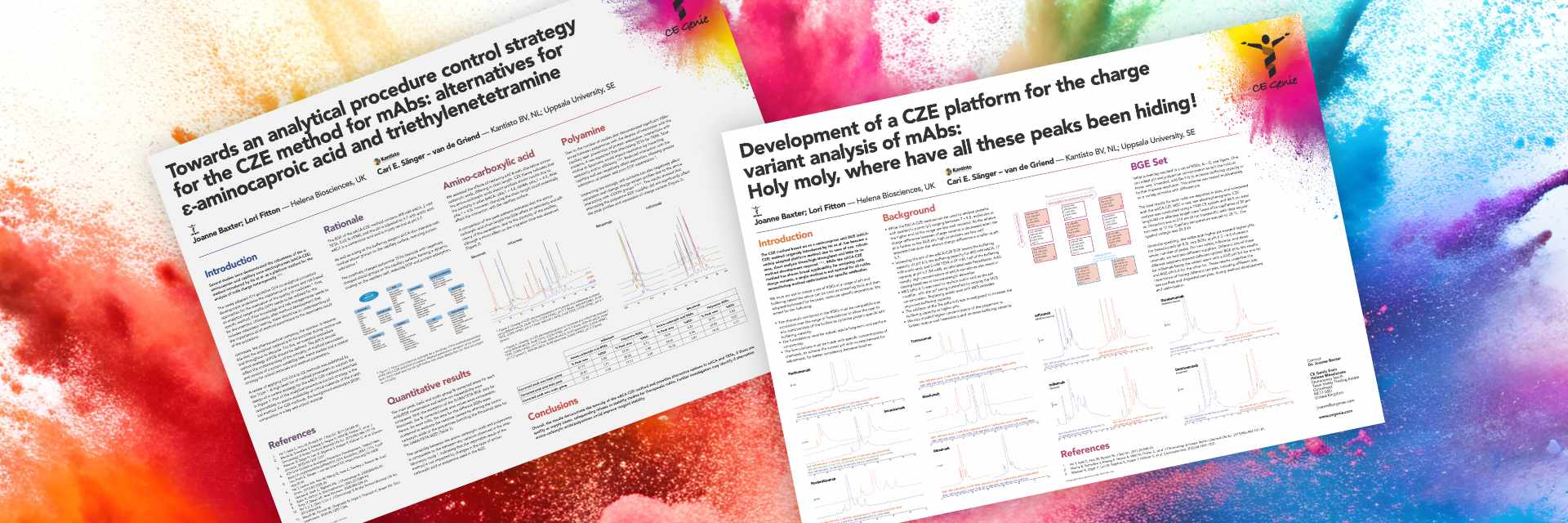
Presented at CEPharm, these posters explore CE Genie’s approach to CZE charge variant analysis, from analytical procedure control strategies and critical materials through to flexible method development and molecule-specific separation optimisation.
The bundle includes:
A look at how alternative BGE components may support method robustness, supply continuity and analytical procedure lifecycle control.
A demonstration of how varying pH, buffering capacity and polyamine concentration can improve charge variant resolution across different mAbs.
Enter your email address to access CE Genie resources*.
We’ll store a cookie in your browser for 30 days, only to record that you have access to these materials. We don’t track site visitors at all. Your email address will be used to follow up and you can be included in our mailing list by ticking the box above.
Let’s find out how we can work together on your process and method development.